Catch what a clean lookup misses
Reincarnated authorities, rented MC numbers, insurance lapses, safety against peers. The whole federal record on any carrier, read for you, with no account and no card.
Free on any carrier. No account, no card.
Everything on a carrier, in one report
Authority, insurance, inspections, safety history, ownership. Everything you check when you vet a carrier, pulled into one place and stated as facts.
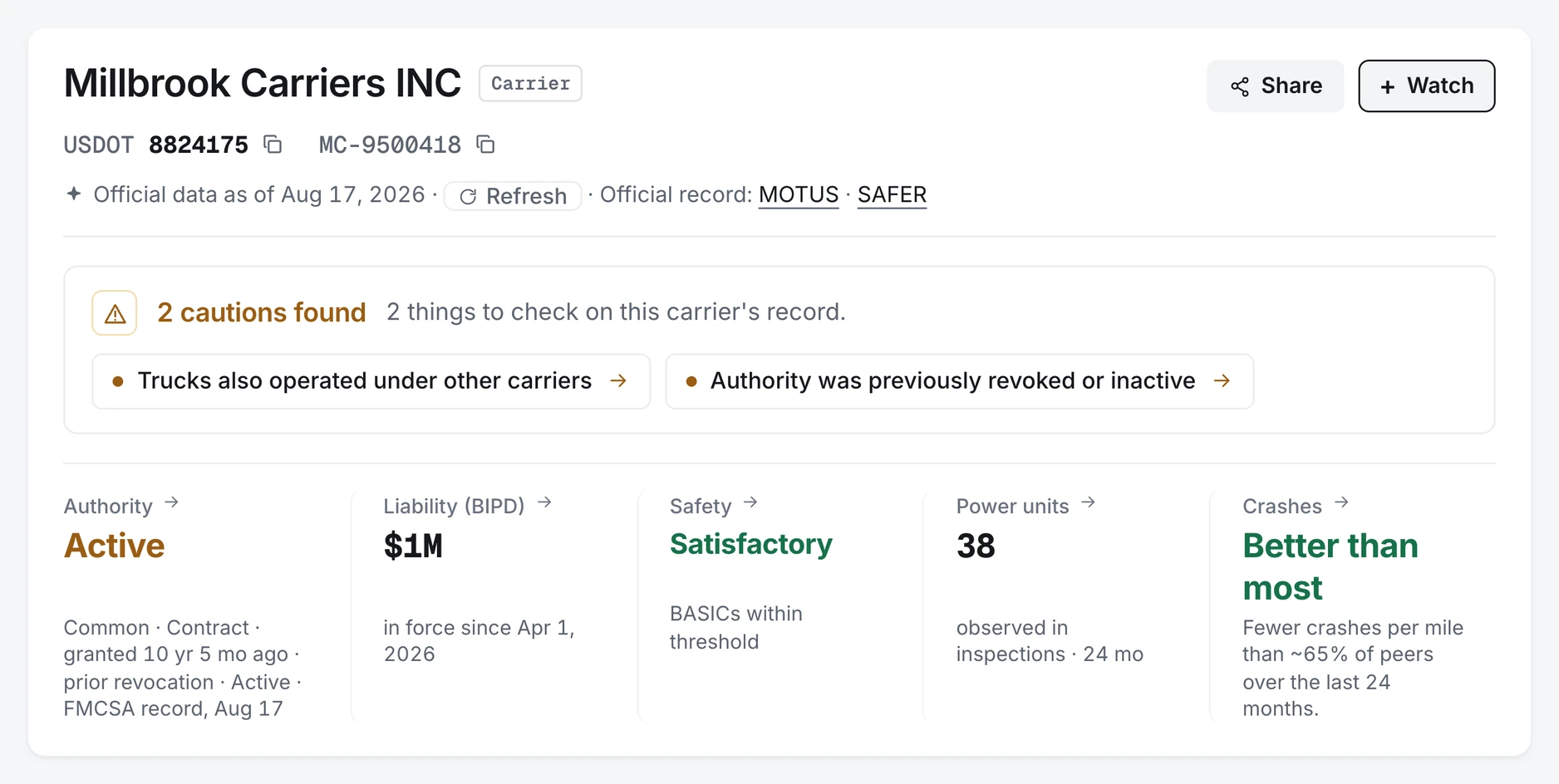
The top of a report. The verdict comes first, then the record behind it: authority, insurance on file, safety against peers, and the trucks actually seen on the road. Cautions are named, not scored, and each one opens to the filing it came from. The line under the name says when the official data was read, and links straight to it. An illustrative composite: the carrier is fictional, its DOT number is unissued, and every figure in frame was authored for this image. The same report is free on any carrier.
Fraud patterns caught in every report
Freight fraud usually leaves a paper trail in the federal record. fleetfax looks for the patterns brokers get burned by and raises them as cautions, so you make the call with them in front of you. A few of the things it watches for:
How stolen loads actually start
These plays start at a desk, not a truck stop. The thief books the load as somebody else, or as a company built to be burned, and the freight is gone before anyone knows to look. Each play leaves marks in the federal record. Here's where the report puts them in front of you.
Measured against carriers with a similar record
Ten violations mean one thing at five hundred inspections and another at twelve. fleetfax compares each carrier against others with a similar inspection record.
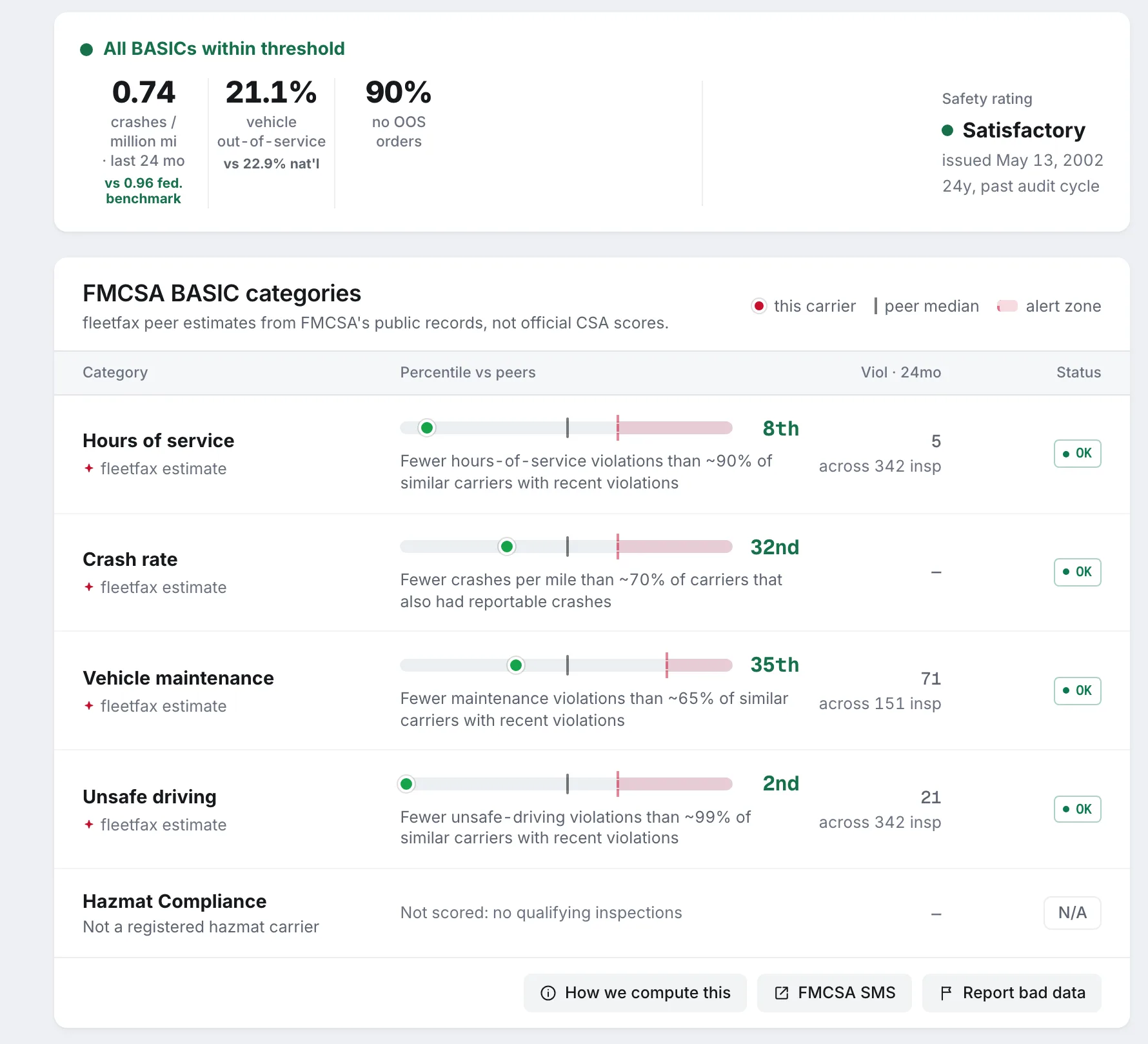
Every carrier gets a percentile. Each one is grouped with carriers with a similar amount of inspection activity, then ranked on violations per inspection from the public record. The comparison pool is carriers that also had recent violations, and each row says so; crash rate is its own pool, measured per mile against carriers that also had recordable crashes. The status column is shorthand for where that percentile sits against FMCSA's alert threshold. A higher percentile means more violations than peers, not a pass or a fail. FMCSA keeps its own percentiles hidden, so these are fleetfax estimates built from the same public records, not official CSA scores.
Every filing and lapse, going back years
Not just today's snapshot. The full run of authority events and insurance filings, side by side, so a gap that closed two years ago still shows.
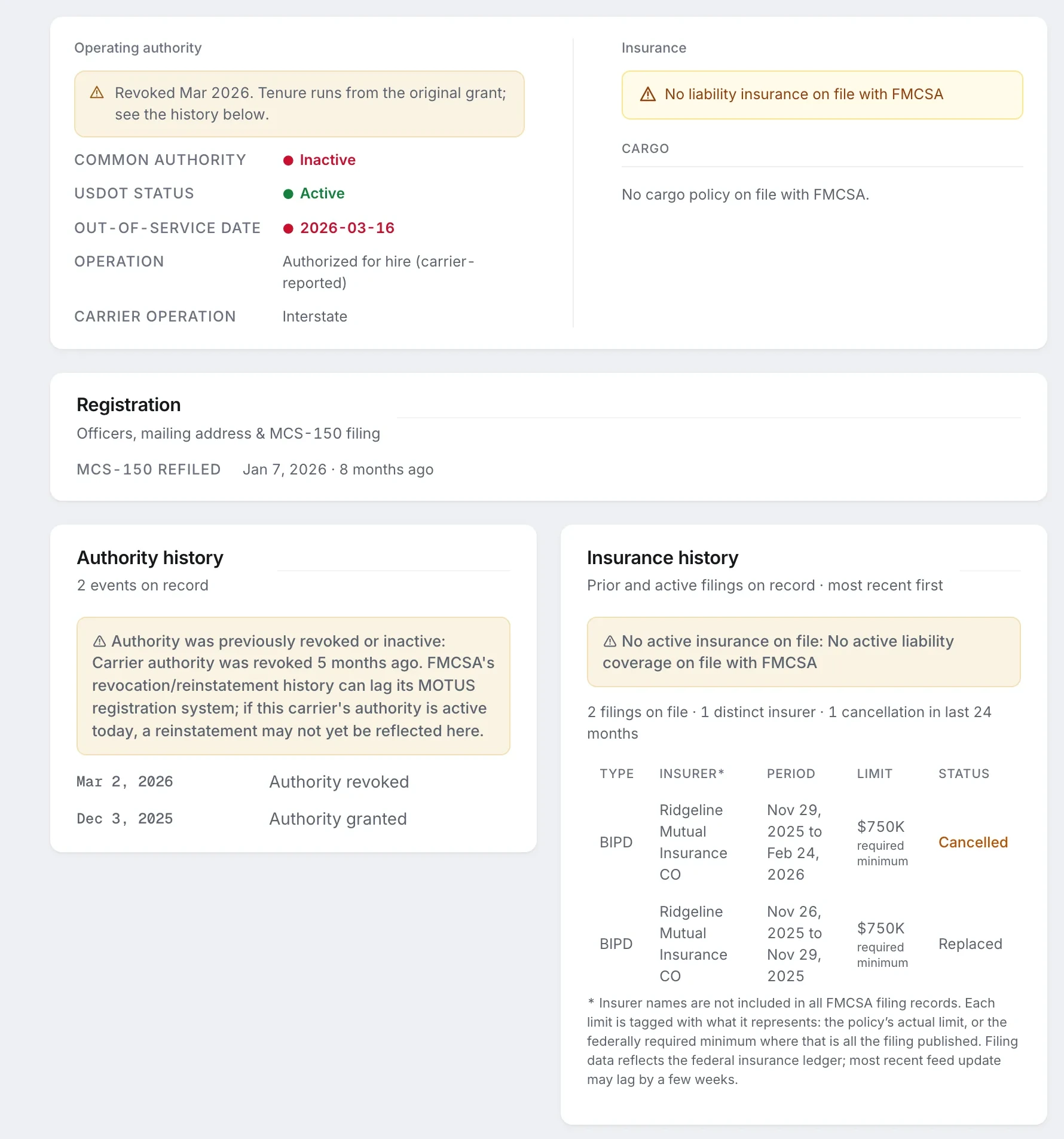
Granted in December, revoked by March. An authority barely three months old, next to the insurance ledger that explains it: a $750K policy cancelled with no replacement on file. A packet from onboarding would still say this carrier was covered; the report shows the record as it stands today.
Insurance, live-verified against Motus
Every night, fleetfax checks unclear insurance records against FMCSA's Motus system, the registration system of record. When the public feeds lag, fleetfax corrects the insurance record to match what Motus shows.
Read the researchThe trucks actually seen on the road
Counted from roadside inspections, next to the number the carrier reports.
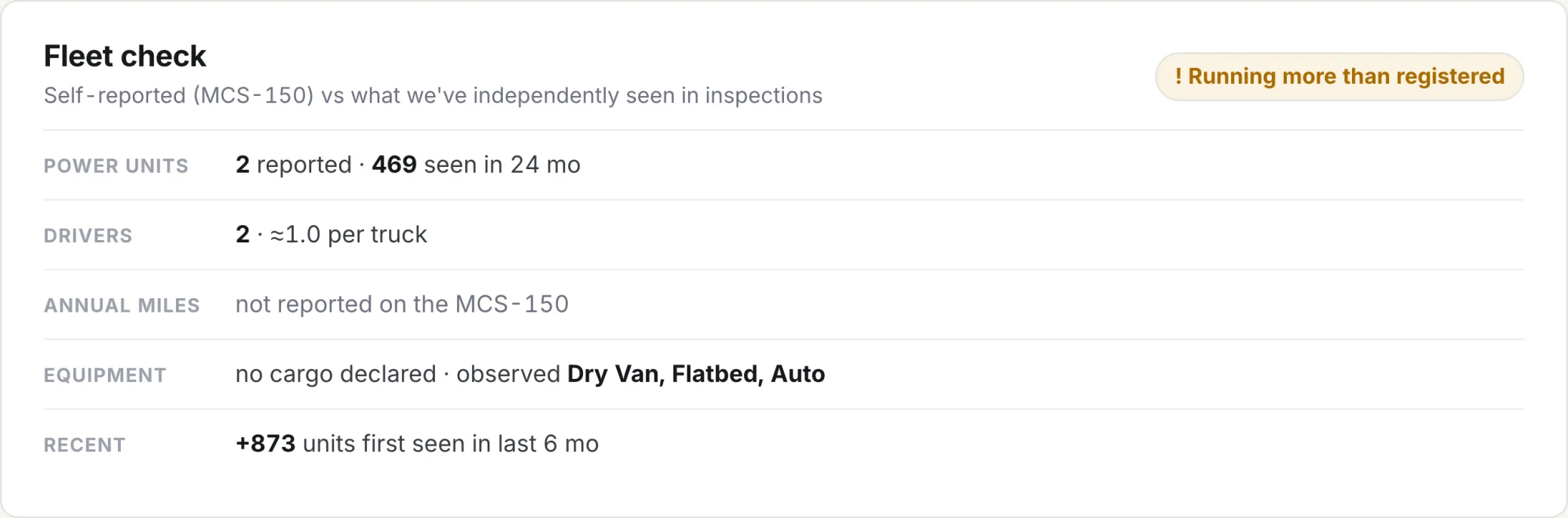
2 reported, 469 observed. This carrier reports 2 power units to FMCSA; inspections saw 469 distinct trucks in 24 months, so the report flags it. Reported and observed are two separate facts, and not every truck gets inspected, so a gap is a reason to ask the carrier, not proof of anything by itself.
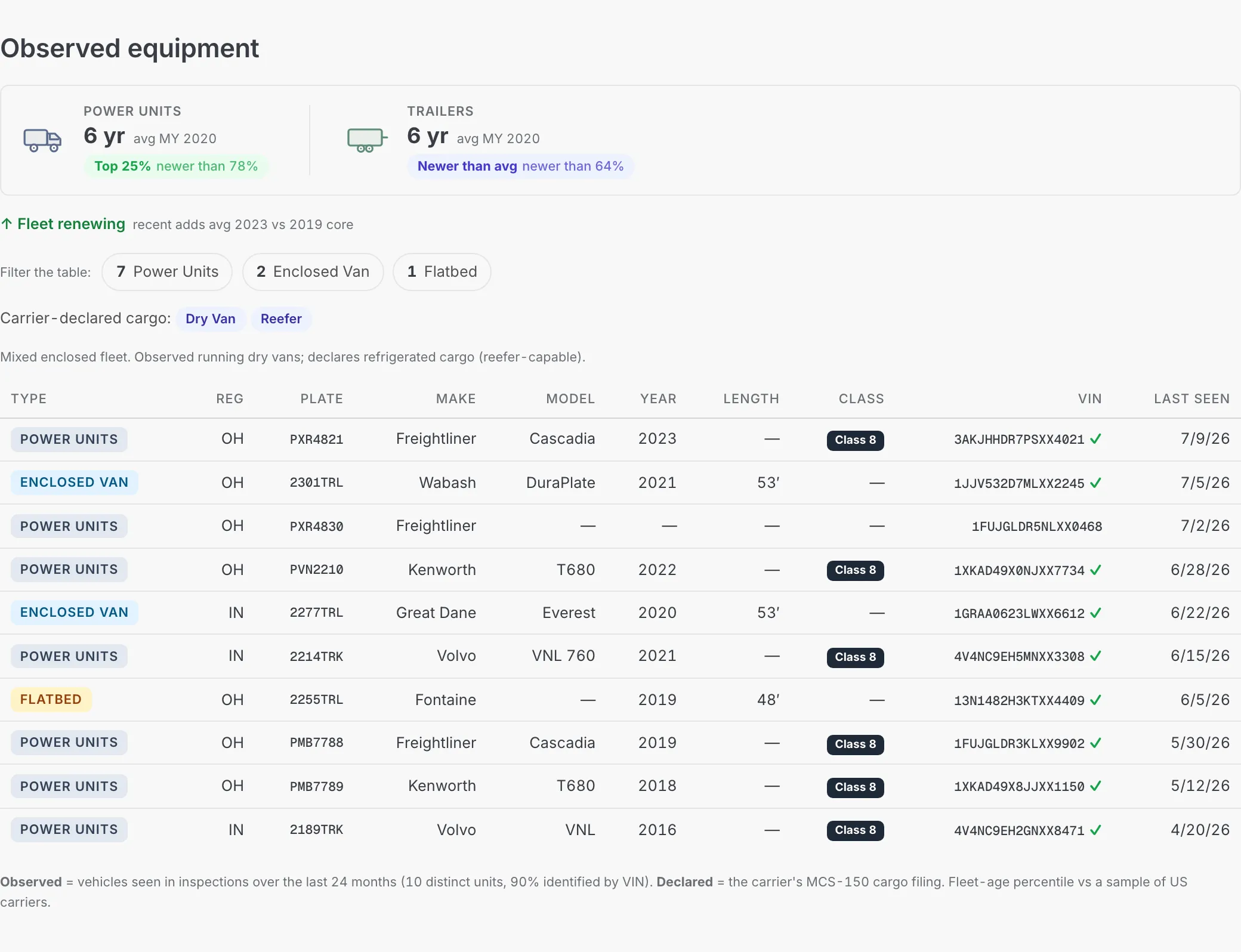
Decoded from roadside-inspection VINs. Each row is one truck or trailer seen in an inspection, with the VIN it was read from and the make, year, and class decoded from it. The carrier and VINs shown are fictional.
Where a carrier was observed
Built from where the carrier's trucks have actually been inspected, not from a service area somebody filled in on a form.
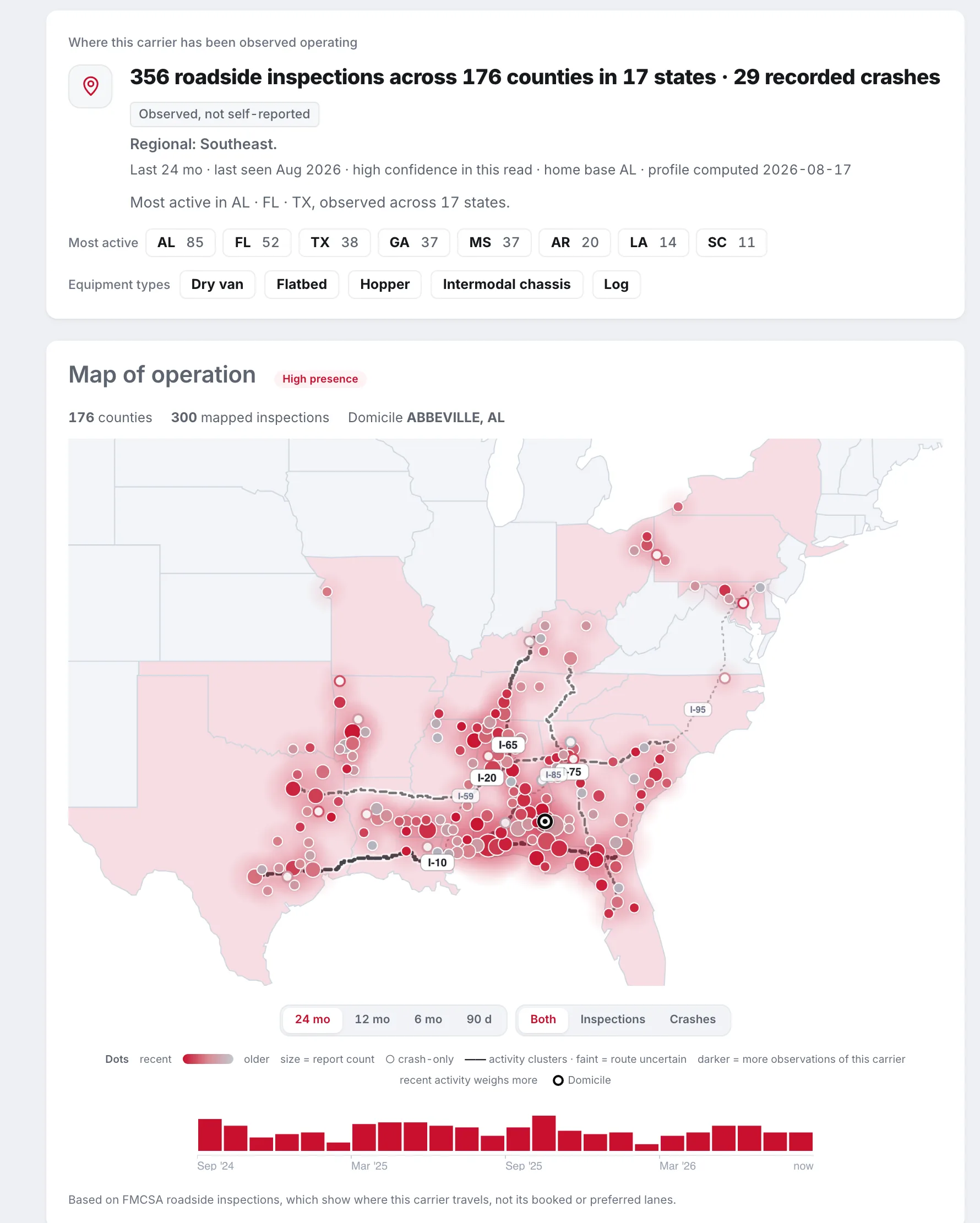
176 counties, 300 mapped inspections. A regional carrier that works the Southeast and stays there. Every dot is a roadside inspection, placed where the truck was actually stopped; the dashed lines are the corridors those stops keep landing on, and the ringed marker is the carrier's registered home base.
The report views on this page are illustrative composites, made in August 2026: the real report, rendered against carriers and figures authored for the images. Carrier names are fictional and their USDOT numbers unissued. The federal record moves daily, so the live report on any carrier will differ.
Vetting one carrier is the easy part
The report stays free on every carrier. A free account lets you hold any carrier you open to your own minimums. Pro is for the days you're running a whole book.
Policy
Build your qualification rules from 17 checks over the federal record, with your thresholds and your grading on each one. Open a carrier and see whether it meets your minimums, and which rule says so. Where the record can't settle a rule, it says so instead of guessing. These are your minimums, not a fleetfax grade. Writing a policy and reading one carrier against it, rule by rule, costs nothing; running it across your whole book is the Pro part.
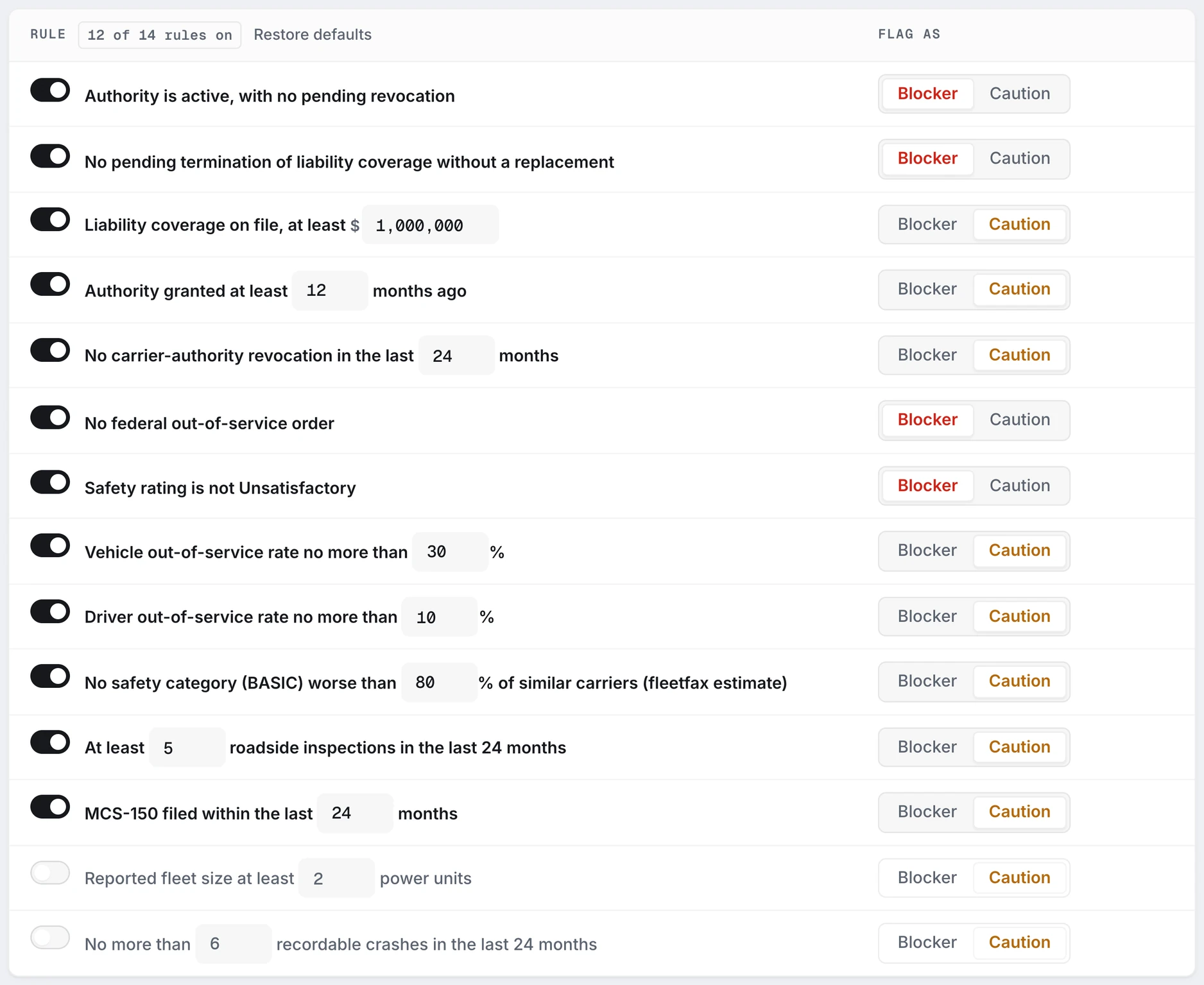
Every rule reads one field of the federal record directly. The numbers are yours, and so is the grading. fleetfax reports the facts against your line and never adds a verdict of its own. An illustrative composite: the rule set shown was authored for this image.
Get notified the day Pro opens
Pro hasn't launched yet. Leave your email and we'll write to you the day it goes live.
You're on the list. We'll email you the day Pro goes live.
fleetfax Pro opens soon, at a launch price you keep for as long as you stay subscribed.